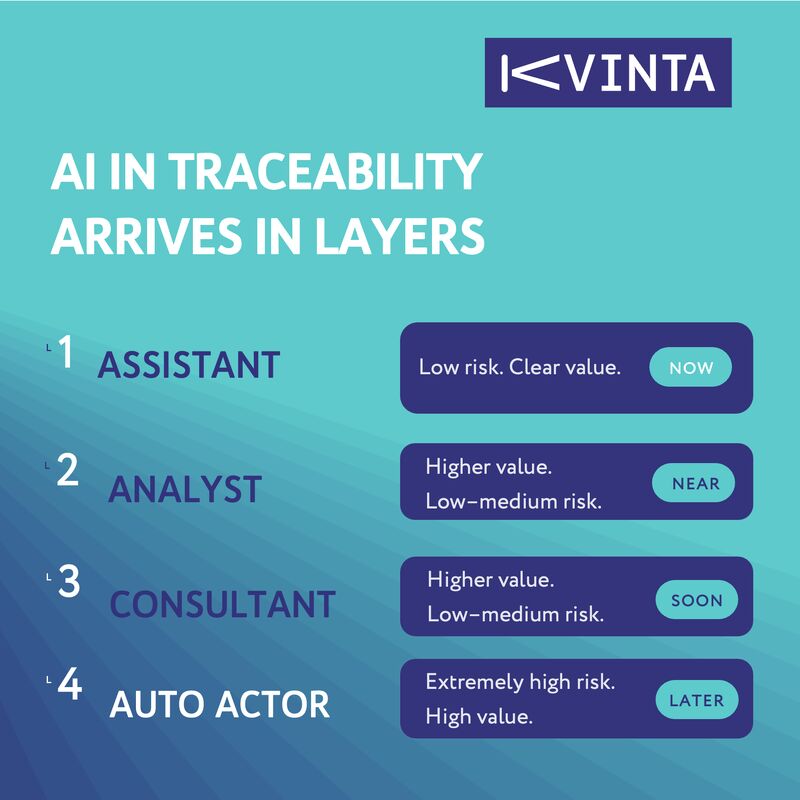
AI in traceability will not arrive as one big switch. It will arrive in layers.
And each layer needs a different level of trust.
🤌 Follow our page to get the latest on Serialization and Traceability!
👾 Layer 1: AI as assistant
Support answers. User guidance. Documentation search. Test scenario generation. Faster onboarding.
Low risk. Clear value.
👾 Layer 2: AI as analyst
Exception clustering. Data quality monitoring. Pattern detection. Risk scoring. EPCIS error explanation.
Higher value. Still controlled.
👾 Layer 3: AI as consultant
Suggested actions for failed transactions, partner issues, suspicious serial number events, or shipment anomalies.
Useful, but human approval stays in the loop.
👾 Layer 4: AI as autonomous actor
Changing product status. Resolving exceptions. Triggering regulatory or partner-facing actions. Acting inside production traceability systems.
This is where the bar becomes extremely high.
In serialization, one wrong decision can block a shipment, corrupt validated data, create compliance risk, or affect product availability.
❓ So the question is: “Can AI do it consistently, explainably, repeatedly, and under validation control?”
Our view at Kvinta: AI becomes a powerful layer around serialization and traceability. It will help teams work faster, understand problems earlier, and reduce operational noise.
But the core production system still needs to be reliable, deterministic, auditable, and validated.
In traceability, intelligence is useful. Trust is mandatory.